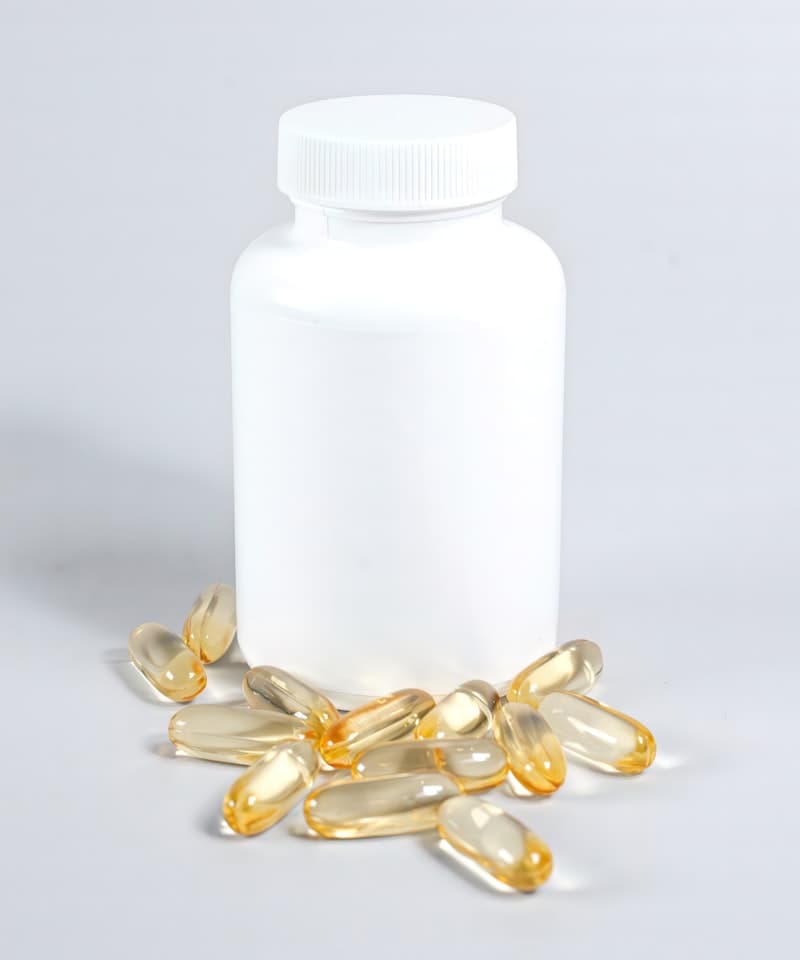
Fish Oil Says 1000mg but Only 300mg EPA/DHA? Here's Why
Your fish oil says 1000mg but the back shows only 300mg EPA/DHA — here's why, how to read the label, and the pill-math to hit your real omega-3 dose.
Fish Oil Says 1000mg but Only 300mg EPA/DHA? Here's Why
I flipped my bottle over and did the math, and honestly, I felt a little cheated for a minute.
The front said "Fish Oil 1000mg" in big, confident letters. Then I turned it around, read the Supplement Facts panel, and there it was: EPA 180mg, DHA 120mg. Add those up and you get 300mg. So where did the other 700mg go? Was I paying for a big number that meant nothing?
Here's the short version, and it's good news: you're (probably) not being ripped off. That 1000mg is real — it's just not measuring what you think it's measuring. Once you understand the one thing the front label is actually counting, the whole bottle stops being confusing and starts being easy to read.
This guide goes in three moves. First, why the two numbers are different. Then how to read the Supplement Facts panel line by line without falling for the common traps. And finally the fun part — the pill-math: how to calculate exactly how many softgels you need to hit your real omega-3 target. Grab your own bottle if you've got one nearby. We're going to decode it together.
The Short Answer — "1000mg" Is Total Fish Oil, Not Omega-3
The "1000mg" (or 1200mg, or 1500mg) on the front is the total weight of fish oil in each softgel. That's it. It's the whole oil.
Fish oil is not pure omega-3. It's a blend of fats, and only a slice of that blend is the stuff you actually care about — the long-chain omega-3s EPA (eicosapentaenoic acid) and DHA (docosahexaenoic acid). The rest is other fatty acids and oil that ride along for free.
In a standard, non-concentrated fish oil, EPA and DHA make up roughly 30% of the total oil. That's why a 1000mg softgel so often lands at about 300mg of EPA+DHA. In fact, the NIH Office of Dietary Supplements uses this exact example: a typical fish oil supplement provides about 1,000 mg of fish oil containing 180 mg EPA and 120 mg DHA, though amounts vary widely by product (NIH Office of Dietary Supplements, "Omega-3 Fatty Acids," Health Professional Fact Sheet, 2024). Look familiar? That's the 180/120 split printed on my bottle, and probably yours too.
So the front number and the back number aren't contradicting each other. One is measuring the container (total oil), the other is measuring the contents that count (EPA+DHA). It's a labeling convention, not a scam. The catch is that a bigger front number doesn't automatically mean more omega-3 — because a low-concentration oil and a high-concentration oil can both say "1000mg" while delivering wildly different amounts of EPA+DHA.
That last point is the whole game, so let's decode it.
Decode the Front Label — What "1000mg" Actually Buys You
The single most useful reframe: stop reading the front number as "how much omega-3" and start reading it as "how much oil, at some concentration I need to go check." The concentration (%) is what turns that raw oil weight into real EPA+DHA.
Standard fish oils sit around 30%. Concentrates are refined to pack more EPA+DHA into the same gram of oil — often 50-60% or higher — which is why two bottles that both say "1000mg" can be totally different products. Here's a decoder for the patterns you'll see on shelves:
TABLE A — Front-Label Claim → Real EPA+DHA
| Front-label claim | Typical concentration | Est. EPA+DHA per softgel | What to check on the back |
|---|---|---|---|
| "1000mg fish oil" (standard) | ~30% | ~300mg | Add the EPA + DHA lines (not total fish oil) |
| "1200mg fish oil" (standard) | ~30% | ~360mg | Is the serving size 1 softgel or 2? |
| "1000mg fish oil" (concentrate) | ~50-60% | ~500-600mg | Confirm it actually says "concentrated" / lists high EPA+DHA |
| "Triple strength / high-EPA" | ~65-75% | ~650-750mg | Read EPA+DHA total, not "Total Omega-3s" |
Concentration figures here are typical product-category patterns, not a promise about your specific bottle. The 30% standard figure lines up with the NIH ODS example above. Your product's real value is always on the back panel — never assume, always verify.
The takeaway from the table is blunt: "1000mg" alone tells you almost nothing until you know the concentration. A "1000mg" concentrate can hand you twice the EPA+DHA of a "1200mg" standard oil. This is the same reason it pays to read any supplement panel closely rather than trusting the marketing side — the same lesson applies when you're comparing something like turmeric versus curcumin extracts, where the "big number" and the active dose also come apart.
Read the Supplement Facts Panel Line by Line
Now the actual skill: reading the back. This is where products quietly inflate their apparent dose, and where you take the number into your own hands. Four traps to watch for.
Trap 1 — The serving size. Before you read a single milligram, find the line that says "Serving Size." If it says "2 softgels," then every number in that panel — including EPA and DHA — is the total for two softgels, not one. Miss this and you'll think each pill has twice what it really does. This one gets people constantly.
Trap 2 — Per serving vs. per softgel. Once you know the serving size, get down to a per-softgel number so you can compare bottles fairly. If the panel lists 600mg EPA+DHA per serving and the serving is 2 softgels, that's 300mg per softgel. Simple division, but you have to actually do it.
Trap 3 — "Total Omega-3s" vs. "EPA + DHA." Some panels headline a line like "Total Omega-3s 600mg." That total can include other omega-3s — ALA, DPA — that aren't EPA or DHA. EPA and DHA are the long-chain omega-3s that the research on heart, brain, and inflammation actually studies, so those are the numbers to count (NIH ODS, 2024). If a label brags about "Total Omega-3s" but buries the EPA and DHA lines, look harder. (For more on why EPA and DHA are the parts that matter, see our omega-3 science guide.)
Trap 4 — The "Fish Oil" line vs. the "EPA/DHA" lines. A panel often reads something like "Fish Oil Concentrate 1000mg" up top, then "EPA 180mg / DHA 120mg" underneath. The top line is the total oil (your front-label number). The lines underneath are what you're really buying. Don't let the big 1000mg on the panel fool you twice.
The 2-Softgel Serving Trick
This deserves its own callout because it's the most common way a label looks more impressive than it is.
Say a bottle proudly lists "1200mg EPA+DHA." Great, right? Then you find, in smaller print, "Serving Size: 2 softgels." That's 600mg per softgel — still solid — but if you were planning to take one a day, you're getting half of what the headline implied. The manufacturer isn't necessarily lying; they've just chosen a serving size that makes the panel number bigger. Your defense is a two-second habit: read the serving size first, then divide.
Do the Math Yourself — The Concentration Formula
Here's the one formula that lets you decode any bottle on the spot. It answers "what percentage of this oil is actually the good stuff?"
Concentration % = [(EPA mg + DHA mg) ÷ Total fish oil mg] × 100
Let's run my bottle through it:
- Standard example: (180 + 120) ÷ 1000 × 100 = 30%. Textbook standard fish oil. Nothing wrong with it — this is normal.
- Concentrate example: a bottle listing 330mg EPA + 220mg DHA in 1000mg of oil → (330 + 220) ÷ 1000 × 100 = 55%. That's a concentrate, and it'll take fewer pills to reach the same dose.
One line to remember: the higher the concentration, the fewer softgels you need for the same EPA+DHA. Concentration is the lever. Total oil weight is just the raw material.
Do this once with your own bottle and you'll never be confused by a fish oil label again. Which brings us to the actual reason most people are checking: how many do I take?
How Many Softgels Do You Actually Need? (Pill-Math)
This depends on two things: your daily EPA+DHA target and your product's EPA+DHA per softgel. Divide the first by the second, round up, done.
Before the table, a quick word on targets, because YMYL honesty matters here. For general maintenance, eating about 8 ounces of a variety of seafood a week gets you roughly 250mg of EPA+DHA per day, which is a commonly cited general-population intake (NIH ODS, 2024). Many people aim for the 250-500mg/day range from food or a supplement. Higher doses — the kind sometimes used to lower triglycerides — are a different situation: the NIH ODS notes that people using omega-3s to manage triglycerides should do so under the care of a healthcare provider, and the FDA's position is that combined EPA+DHA intake shouldn't exceed 3g/day total, with no more than 2g/day from supplements (NIH ODS, 2024). So treat the 2,000mg row below as a "talk to your doctor first" scenario, not a casual default.
TABLE B — Softgels Needed (Daily Target × Product Concentration)
| Daily EPA+DHA target | 300mg/softgel | 500mg/softgel | 700mg/softgel |
|---|---|---|---|
| 500mg (general) | 2 | 1 | 1 |
| 1,000mg | 4 | 2 | 2 |
| 2,000mg (higher intake) | 7 | 4 | 3 |
Cells are rounded up to whole softgels (e.g., 2000 ÷ 300 = 6.7 → 7). The higher-intake row is prescription-adjacent territory — use it only under a healthcare provider's guidance.
A Worked Example
Let me walk my own bottle through it. Mine is standard: 300mg EPA+DHA per softgel.
If I just want general cardiovascular-support levels, say 500mg/day, that's 500 ÷ 300 = 1.7 → 2 softgels. Easy.
But suppose a doctor asked me to hit 2,000mg/day for triglyceride management. With my 300mg softgels, that's 2000 ÷ 300 = 6.7 → 7 softgels a day. Seven pills, seven times the calories from the oil, and seven times the cost — every single day. At that point the smart move is to switch to a concentrate. A 700mg-per-softgel product gets me to 2,000mg in 2000 ÷ 700 = 2.9 → 3 softgels. Same dose, less than half the pills.
That's the practical reason concentrates exist. For low targets, a cheap standard oil is completely fine. For high targets, concentration is what keeps the pill count sane. If you're going high-dose and start noticing side effects, it's worth knowing what's dose-related and what isn't — for example, the small subset of people who report breakouts after starting fish oil.
Pills vs. Salmon — What If I Just Ate the Fish?
Sometimes the pill count only makes sense once you picture it as food. So how does a softgel stack up against an actual piece of fish?
According to USDA FoodData Central, 100g of cooked farmed Atlantic salmon contains about 690mg EPA and 1,460mg DHA — roughly 2,150mg of EPA+DHA in one modest fillet-sized serving (USDA FoodData Central, "Fish, salmon, Atlantic, farmed, cooked, dry heat," FDC ID 175168).
TABLE C — Food vs. Softgels
| Source (per ~100g cooked) | EPA + DHA | ≈ standard 300mg softgels |
|---|---|---|
| Farmed Atlantic salmon | ~2,150mg | ~7 |
Individual EPA and DHA figures from USDA FoodData Central for farmed, cooked Atlantic salmon. Wild salmon and other species vary.
Put another way: one good serving of salmon delivers about the same EPA+DHA as seven standard 300mg softgels. That reframes the whole thing. A couple of salmon (or sardine, or mackerel) dinners a week can quietly cover a maintenance-level omega-3 intake without a single pill — which is exactly the case for getting more of your nutrients from whole anti-inflammatory foods when you can. Supplements shine when you don't eat much fish or you need a precise, repeatable dose.
Practical Takeaways — When the Big Number Actually Matters
Here's everything above, boiled down to what to do the next time you're holding a bottle:
- Read the back, not the front. The front's "1000mg" is total oil. Add the EPA and DHA lines to get what counts.
- Check the serving size first. If it's "2 softgels," every number on the panel is for two. Divide before you compare.
- Count EPA+DHA, not "Total Omega-3s." The total can hide filler omega-3s that aren't EPA or DHA.
- Match the product to your goal. Low target (general maintenance)? A standard 30% oil is fine and cheap. High target (doctor-directed)? A concentrate saves you a fistful of pills.
- Bigger isn't better — concentration is. A "1000mg" number tells you nothing until you know the percentage. Run the formula.
The Bottom Line
The big number on the front is total fish oil. The number that matters is EPA+DHA on the back. Those two things were never supposed to be equal, and once you know that, the "1000mg but only 300mg" mystery evaporates.
You now have everything you need to decode any bottle: one formula — (EPA + DHA) ÷ total oil × 100 — to find the concentration, and one table to turn your daily target into a pill count. That's the whole skill.
So go do it. Flip your bottle over, add the EPA and DHA lines, drop the numbers into the formula, and see what concentration you're actually getting. Standard 30%? A sneaky concentrate? Tell us what your bottle came out to in the comments.
One honest caveat to close on: everything here is about decoding labels and doing arithmetic, not prescribing a dose. General maintenance intakes are one thing; higher therapeutic doses for triglycerides or any medical condition are a conversation to have with your doctor or pharmacist, especially if you take blood thinners.
References
- National Institutes of Health, Office of Dietary Supplements. "Omega-3 Fatty Acids — Health Professional Fact Sheet." 2024. https://ods.od.nih.gov/factsheets/Omega3FattyAcids-HealthProfessional/
- U.S. Department of Agriculture, Agricultural Research Service. "Fish, salmon, Atlantic, farmed, cooked, dry heat." FoodData Central, FDC ID 175168. https://fdc.nal.usda.gov/food-details/175168/nutrients
Why Does NMN Keep Me Awake at Night? The NAD+ Timing Fix
Next →Is 30g of Protein Per Meal a Myth? The Real Absorption Limit