Foam Roller vs Massage Gun: Which Is Better for Recovery? (Science-Backed 2026)
Foam roller vs massage gun — which is better for recovery? Compare how they work, when to use each, and what science says about both in this 2026 guide.
Foam Roller vs Massage Gun: Which Is Better for Recovery? (Science-Backed 2026)
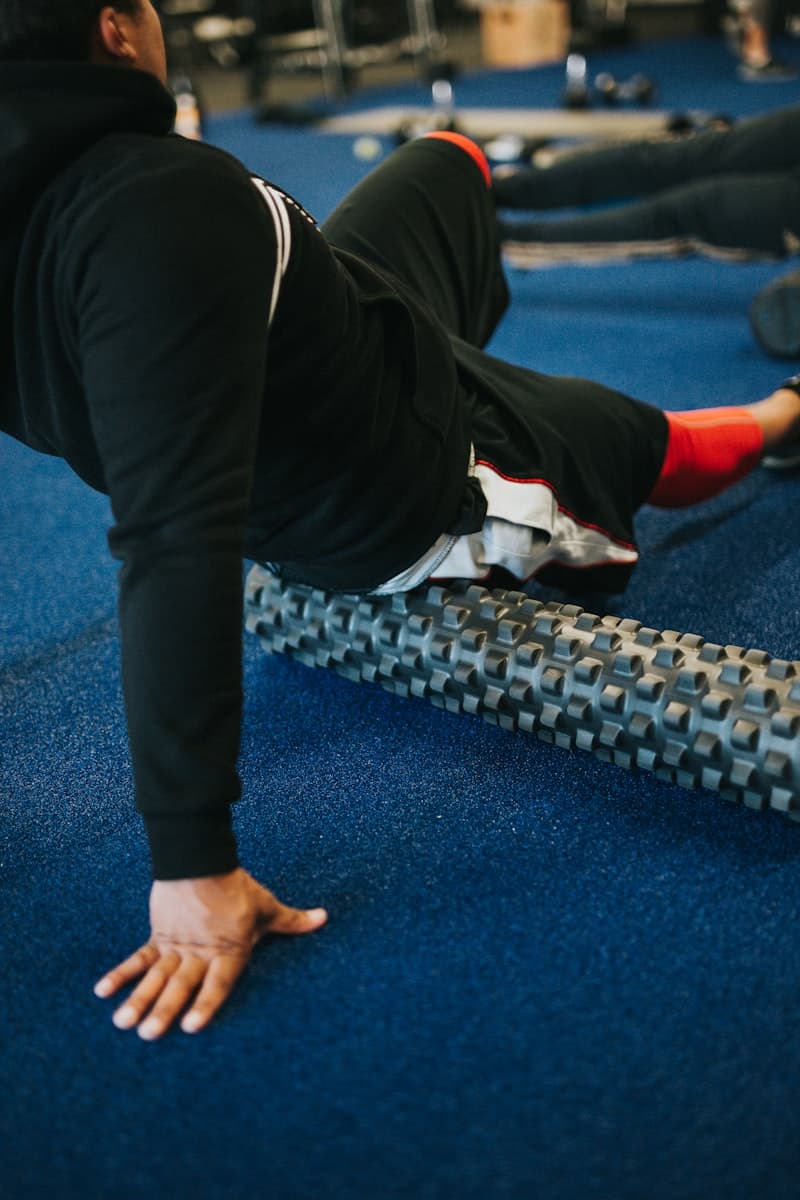
You spent $300 on a massage gun because a fitness influencer said it would change your recovery. Or maybe you bought a $25 foam roller because your physical therapist recommended it. Either way, you are standing in your living room wondering if you picked the right one. The foam roller vs massage gun question is everywhere right now, and most of the answers online are either sponsored content or vague hand-waving about "blood flow."
I have gone through the meta-analyses, the randomized controlled trials, and the systematic reviews on both tools. The short version: they are not competitors. Foam rollers and massage guns work through different mechanisms, excel at different things, and for most people, the best results come from using both. But the details matter -- especially if you are dealing with specific issues like back pain, DOMS, or tight IT bands.
The massage gun market has grown into a multi-billion-dollar category, and foam rollers continue to grow steadily alongside them. A 2025 study published in the Journal of Functional Morphology and Kinesiology directly compared both tools against a passive-rest control for delayed-onset muscle soreness (DOMS) -- one of the few studies to test them head-to-head. The research base has matured enough that we can now give honest, evidence-based answers instead of guessing.
Here is what the science actually says about foam rollers vs massage guns, how each one works, when to use which, and whether you can replace one with the other.
Quick Answer — Foam Roller or Massage Gun?
Foam rollers use broad, sustained pressure to release tight fascia and improve mobility across large muscle groups. Massage guns deliver targeted percussion therapy that penetrates deeper tissue for quick pain relief. Foam rollers are better for full-body mobility and warm-ups; massage guns excel at pinpointing knots and speeding up localized recovery. For most people, using both gives the best results.
If that is all you needed, no hard feelings. But if you want the evidence behind that answer -- the specific studies, the mechanisms, the head-to-head comparisons -- read on.
| Foam Roller | Massage Gun | |
|---|---|---|
| What it does | Broad pressure to release fascia and improve range of motion | Targeted percussion to break up knots and reduce tension |
| Best for | Full-body mobility, warm-ups, budget recovery | Deep knots, targeted pain relief, quick post-workout recovery |
| Cost | $15-50 | $100-600+ |
| Learning curve | Low — intuitive rolling motions | Moderate — correct attachment and pressure matter |
| Bottom line | Best foundation for mobility work | Best for precision and speed |
How Foam Rolling Works (The Science)
The foam rolling benefits science points to are grounded in a mechanism called self-myofascial release (SMR). You use your own body weight to apply sustained pressure to muscle and fascia -- the thin connective tissue that wraps around every muscle in your body. When that fascia gets sticky, tight, or knotted up from training, poor posture, or just sitting at a desk all day, it restricts movement and creates discomfort. Foam rolling addresses that directly.
The Myofascial Release Mechanism
Here is what is actually happening when you lie on a foam roller and grimace.
Your muscles are wrapped in fascia -- a continuous web of connective tissue that runs throughout your entire body. Under normal conditions, fascia is smooth and pliable, allowing muscles to slide and contract freely. But repetitive movement patterns, intense exercise, poor posture, and inactivity can cause fascia to thicken, adhere, and form what manual therapists call "adhesions" or "trigger points."
When you place a foam roller under a tight muscle and apply your body weight, you create sustained mechanical pressure on those adhesions. This pressure has several effects:
- Mechanotransduction: The physical deformation of tissue triggers cellular responses that can remodel fascia over time. Fibroblasts (the cells that produce connective tissue) respond to mechanical loading by reorganizing collagen fibers.
- Thixotropic effect: Fascia behaves as a non-Newtonian fluid -- it becomes less viscous (more fluid) when you apply pressure and movement. Think of it like ketchup: sit still and it stays thick, but apply pressure and it flows.
- Neurological relaxation: Sustained pressure on muscle tissue stimulates mechanoreceptors (particularly Golgi tendon organs and Ruffini endings) that signal your nervous system to reduce muscle tone. Your muscle literally relaxes because your brain tells it to.
A 2020 systematic review and meta-analysis by Skinner, Moss, and Hammond published in the Journal of Bodywork and Movement Therapies analyzed 32 studies on foam rolling. They found a large effect size (d = 0.76, 95% CI 0.55-0.98) for range of motion improvement. That is not a subtle finding. Across 18 datasets from 13 ROM studies, foam rolling consistently increased joint range of motion. It is worth noting that the evidence for benefits beyond range of motion (such as performance or recovery markers) was less conclusive.
Blood Flow and Range of Motion
Foam rolling also improves local blood flow to the tissues being worked. The combination of pressure and movement creates a pumping effect on blood vessels -- compressing on the roll, releasing as you move past -- which enhances circulation. Better blood flow means more oxygen and nutrients delivered to recovering muscle tissue, and faster clearance of metabolic waste products.
The range of motion improvements are the most consistently documented benefit of foam rolling. The 2019 meta-analysis by Wiewelhove and colleagues in Frontiers in Physiology -- one of the most cited papers on the topic -- found that pre-exercise foam rolling improved flexibility by approximately 4% (g = 0.34). Post-exercise foam rolling reduced perceived muscle soreness by about 6% (g = 0.47) and slightly attenuated performance losses in sprint and strength measures.
I want to be honest about what these numbers mean. A 4% improvement in flexibility and a 6% reduction in soreness are real, measurable effects. They are not transformational. No one is going from barely touching their shins to doing the splits because of a foam roller. But for athletes trying to squeeze marginal gains out of their recovery, or for anyone dealing with chronic tightness that limits training, the evidence supports regular foam rolling as a useful tool.
One notable conclusion from the Wiewelhove meta-analysis: the evidence "seems to justify the widespread use of foam rolling as a warm-up activity rather than a recovery tool." Foam rolling before exercise showed more consistent benefits for performance than foam rolling after exercise did for recovery. That does not mean post-workout foam rolling is useless -- the soreness reduction data is legitimate. But if you only have time for one foam rolling session, pre-workout may give you more bang for your buck.
What Type of Foam Roller Should You Use?
Not all foam rollers are the same, and picking the wrong one can turn a recovery session into an exercise in misery.
Density matters most. Foam rollers generally come in three densities:
- Low density (soft): Best for complete beginners, older adults, or anyone recovering from injury. Feels like pressing into a firm pillow. Less effective for deep tissue work but much more tolerable.
- Medium density: The sweet spot for most people. Firm enough to create real pressure on adhesions, soft enough that you can actually stay on the roller long enough for it to work. Typically made from EVA (ethylene-vinyl acetate) foam.
- High density (firm): Feels like rolling on a pipe. Effective for experienced users with dense muscle tissue, but brutal on beginners. Often made from EPP (expanded polypropylene).
Texture vs smooth: Smooth rollers provide even, consistent pressure across the contact area. Textured rollers (grids, ridges, knobs) create more concentrated pressure points that can target trigger points more aggressively. Beginners should start smooth and graduate to textured if needed.
Vibration foam rollers deserve a mention here. A 2022 systematic review and meta-analysis by Alonso-Calvete and colleagues in Sports Medicine - Open looked specifically at vibration foam rollers (VFR) and found they may offer additional benefits over standard foam rollers for pain reduction and range of motion, though the authors noted the overall evidence base remains limited. The vibration adds a mechanical stimulus that appears to enhance the thixotropic effect on fascia. The downside: vibration rollers cost $50-150 compared to $15-30 for a standard foam roller.
Size: For most people, a 36-inch (90cm) foam roller is the most versatile option. It is long enough to support your full spine for thoracic extension work and stable enough for beginners. An 18-inch (45cm) roller is more portable but less stable for full-body exercises.
Recommendation for beginners: A 36-inch, medium-density, smooth EVA foam roller. This combination hits the balance between effectiveness and comfort that keeps people using it past the first week. Cost: roughly $20-35.
How Massage Guns Work (The Science)
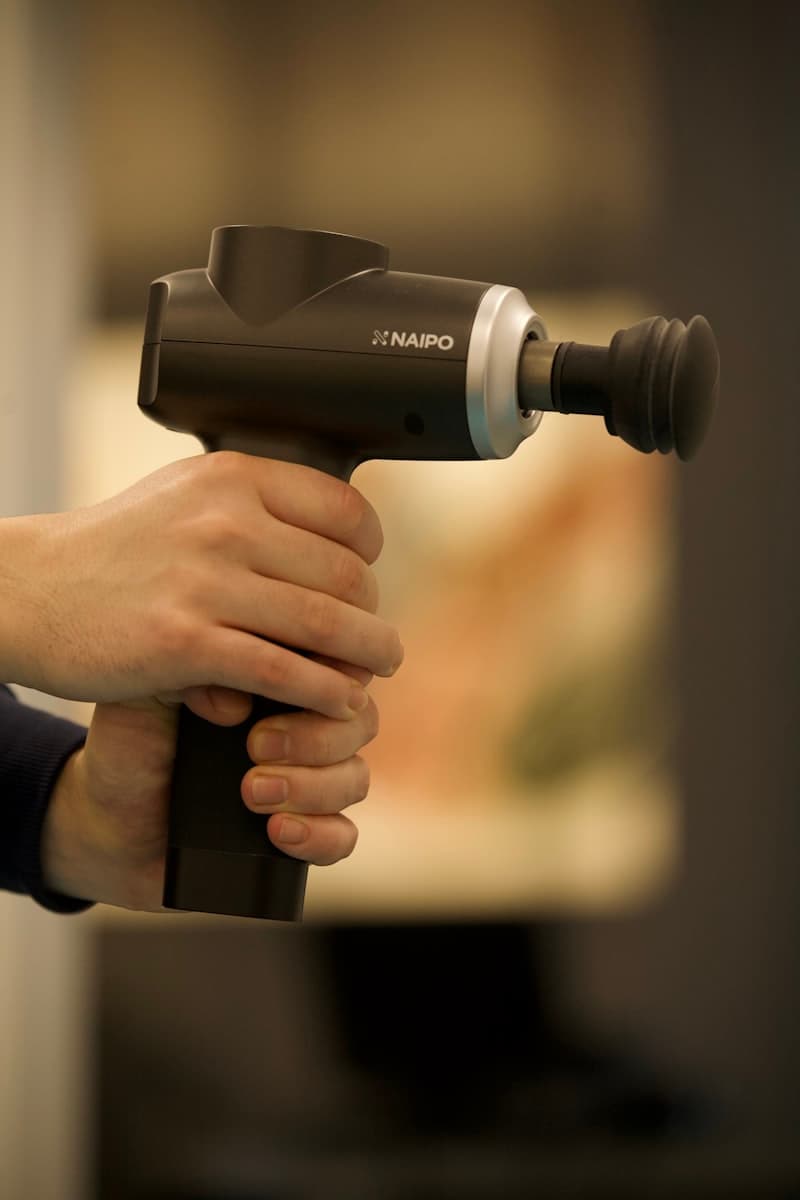
The massage gun benefits for muscle recovery come from a fundamentally different principle than foam rollers. Instead of sustained, broad pressure, they deliver rapid, targeted percussion strokes that penetrate deep into muscle tissue. Understanding the difference between percussion and vibration is key to understanding why massage guns feel so different from other recovery tools -- and why the research on them is more mixed than you might expect.
Percussion vs Vibration — What Is the Difference?
The percussion massage vs vibration therapy distinction matters more than most people realize. These two terms get used interchangeably in marketing material, but they describe different mechanical actions.
Percussion involves a striking motion -- the massage head physically impacts the skin and underlying tissue with each stroke, then retracts. Think of it like hundreds of tiny punches per minute. The stroke depth (how far the head travels with each impact) determines how deep the force penetrates. Most quality massage guns operate at stroke depths of 10-16mm, which allows force to reach deep muscle layers.
Vibration involves continuous oscillation without the strike-and-retract pattern. The contact surface buzzes against the skin without the percussive impact. Vibration foam rollers, vibrating massage balls, and some cheaper "massage guns" fall into this category.
The distinction matters because percussion and vibration affect tissue differently. Percussion creates a brief, high-force mechanical deformation of tissue followed by a release. Vibration creates sustained, lower-force oscillation. A 2025 observational study by Clijsen and colleagues published in the International Journal of Sports Physical Therapy investigated the physiological effects of localized percussive therapy using the Theragun device on 26 healthy female participants. They measured changes in skin temperature, deep tissue blood flow, and muscle oxygenation -- providing some of the first direct physiological data on what percussion therapy actually does to tissue. (As an observational study without a control group, its findings describe what happens during application rather than proving a recovery benefit.)
Most quality massage guns from brands like Theragun, Hyperice, and Ekrin Athletics use true percussion mechanisms. Cheaper models ($30-60 range) often use vibration motors that feel similar but do not penetrate tissue as deeply.
Deep Tissue Penetration and Pain Relief
The main selling point of massage guns is their ability to reach deep tissue that foam rollers cannot easily access. The percussion mechanism allows force to travel through superficial tissue layers and reach deeper muscle bellies and their associated fascia.
Here is what the current evidence says about percussion therapy and pain relief:
A 2025 randomized controlled trial by Li and colleagues published in Frontiers in Public Health compared percussion massage therapy to static stretching for DOMS recovery in 30 physically active young men. The researchers induced DOMS through squats, then assigned participants to static stretching, short-duration percussion massage (25 minutes), or long-duration percussion massage (40 minutes). The long-duration percussion group showed significantly greater improvements in jump height, pain scores, knee range of motion, and electromyography measures compared to both the static stretching and short-duration percussion groups at the 48-hour mark.
That sounds impressive, and the effect sizes were large. But here is the catch: 40 minutes of percussion massage is an unusually long session. Most people use a massage gun for 5-10 minutes total. The study suggests that duration matters significantly for percussion therapy's effectiveness, which raises practical questions about how most people actually use these devices.
A separate 2025 study by Ye and colleagues published in the Journal of Strength and Conditioning Research told a different story. Twenty healthy volunteers performed eccentric exercise to induce muscle damage, then received either 5-minute percussion massage sessions or no treatment. The researchers measured muscle soreness, range of motion, arm circumference, and isometric strength at multiple time points up to 168 hours post-exercise. Result: no significant differences between the percussion group and the control group on any measure. The percussion massage did not accelerate recovery.
Two well-designed RCTs published in the same year, reaching opposite conclusions. This is where the science stands right now on massage guns: promising but inconsistent. The differences may come down to treatment duration, the specific muscles treated, the intensity of the muscle damage protocol, or individual variation in response.
What we can say with reasonable confidence:
- Percussion therapy does increase local blood flow and skin temperature, as measured directly in the Clijsen et al. (2025) observational study
- The effect on perceived pain is real for many users -- percussion appears to temporarily increase pressure pain thresholds, meaning it takes more pressure to feel pain in the treated area
- The effect on actual recovery biomarkers (strength recovery, inflammation markers, creatine kinase levels) is inconsistent across studies
- Duration and technique likely matter a lot, and most research protocols use longer sessions than typical consumer use
How to Use a Massage Gun Properly
If you are going to use a massage gun, using it correctly makes a significant difference in both safety and effectiveness. Here is what the evidence and clinical practice suggest.
Choose the right attachment head:
| Head Type | Shape | Best For |
|---|---|---|
| Ball | Round sphere | Large muscle groups (quads, glutes, hamstrings, calves) |
| Flat | Flat disc | Broad muscles (back, chest, large flat areas) |
| U-shape (Fork) | Two-pronged | Areas around the spine, Achilles tendon, forearm |
| Bullet (Cone) | Narrow point | Specific trigger points, deep knots, small muscles |
| Cushion (Padded) | Soft padded ball | Sensitive areas, beginners, bony areas |
Start on the lowest setting. Every massage gun worth owning has multiple speed settings. Begin on the lowest and increase gradually. Higher speed does not automatically mean better results -- it means more intense sensation and deeper penetration, which can cause bruising if your tissue is not prepared for it.
Keep it moving. Do not park the massage gun on one spot for more than 30-60 seconds at a time. Move slowly across the muscle belly. Let the percussion do the work -- you do not need to press hard. The device is delivering mechanical force; your job is to guide it, not to add your own pressure on top.
Use each area for 30 seconds to 2 minutes. Total session time: 5-10 minutes for most recovery purposes.
Areas to NEVER use a massage gun:
- Joints (knees, elbows, ankles, wrists) — no muscle to absorb the percussion, only bone and connective tissue
- Spine directly — the vertebrae and spinal nerves are not designed to take percussive force
- Front of the neck — major blood vessels (carotid arteries) and nerves run through this area
- Armpits and inner groin — dense nerve plexuses and lymph nodes
- Over acute injuries — fresh strains, sprains, or areas with swelling and heat need rest and ice, not percussion
- If you are on blood thinners or have a history of blood clots — mechanical force on muscles can potentially dislodge clots
This last point is not theoretical. Deep vein thrombosis is a contraindication for percussive therapy in clinical guidelines. If you have a history of clotting disorders or take anticoagulant medication, talk to your doctor before using a massage gun.
Foam Roller vs Massage Gun — Complete Comparison Table
If you want the full side-by-side picture on the foam roller vs massage gun for recovery question, this table covers every relevant comparison point:
| Factor | Foam Roller | Massage Gun |
|---|---|---|
| Mechanism | Sustained static pressure (self-myofascial release) | Rapid percussion strokes (percussive therapy) |
| Tissue Depth | Superficial to moderate | Deep tissue penetration |
| Target Area | Broad, large muscle groups | Precise, targeted knots and trigger points |
| Best For | Full-body mobility, warm-ups, IT band, thoracic spine | Deep knots, specific trigger points, quick localized relief |
| DOMS Reduction | Moderate (supported by meta-analyses) | Inconsistent across studies (some positive, some null) |
| ROM Improvement | Strong and consistent (d = 0.76 in meta-analysis) | Less studied, less consistent |
| Ease of Use | Simple — roll on the floor | Moderate — requires correct technique and attachment |
| Portability | Bulky, hard to travel with | Compact, travel-friendly |
| Price Range | $15-50 | $100-600+ |
| Noise Level | Silent | Moderate to loud (varies by model) |
| Learning Curve | Low | Moderate |
| Durability | 1-3 years (foam degrades) | 2-5+ years (motorized) |
| Risk of Injury | Low | Moderate if used incorrectly (bruising, nerve compression) |
| Who Should Avoid | Severe osteoporosis, acute fractures | Blood thinners, deep vein thrombosis, acute injury |
| Core Strength Bonus | Yes — stabilizing on the roller engages core | No — handheld device, no body stabilization required |
A few things worth highlighting from this comparison.
ROM improvement heavily favors the foam roller. The Skinner et al. (2020) meta-analysis found a large effect size (d = 0.76) for foam rolling and range of motion. There is no equivalent body of evidence for massage guns and ROM. If improving flexibility and joint mobility is a primary goal, foam rolling has the stronger research backing.
DOMS evidence is mixed for both, but differently mixed. When researchers have looked at the foam roller vs massage gun for DOMS question directly, foam rolling shows moderate, consistent reductions in perceived soreness (about 6% in the Wiewelhove meta-analysis). Massage guns show larger effects in some studies (Li et al., 2025) but no effect in others (Ye et al., 2025). The honest summary: both tools can help with DOMS, neither is a magic cure, and foam rolling has the more consistent evidence base.
Portability and convenience favor the massage gun. You can use a massage gun standing up, sitting at your desk, or lying on the couch. Foam rolling requires getting down on the floor and having enough space to move. If you travel frequently or want something you can use in your office without attracting stares, the massage gun wins.
Which Should You Choose? Goal-Based Recommendation

Forget the abstract debate. Match the tool to the job. Here is what the evidence and clinical experience support based on what you are trying to achieve:
| Your Goal | Best Choice | Why |
|---|---|---|
| Full-body mobility and flexibility | Foam Roller | Broad pressure releases fascia across large areas; large ROM effect size (d = 0.76) |
| Targeted knot or trigger point | Massage Gun | Percussion penetrates deep to release specific adhesions |
| Post-workout DOMS relief | Both | Foam roller for large muscles + massage gun for stubborn spots |
| Back pain relief | Foam Roller (gentle) + Massage Gun (targeted) | Foam roller for thoracic spine, massage gun with flat head for lower back muscles |
| Pre-workout warm-up | Foam Roller | Increases blood flow and ROM quickly across whole body; Wiewelhove meta-analysis supports pre-exercise use |
| Budget-friendly recovery | Foam Roller | $15-50 vs $100-600+ for a massage gun |
| Travel / on-the-go recovery | Massage Gun | Compact, portable, no floor needed |
| Runners (leg recovery) | Both — Foam Roller first | Foam roll quads/IT band/calves, then massage gun for calf knots |
| Beginners new to recovery tools | Foam Roller | Lower cost, simpler technique, harder to misuse |
| Desk workers with neck/shoulder tension | Massage Gun | Precision targeting of upper trapezius and levator scapulae |
Let me expand on a few of these.
For Runners: Foam Roller vs Massage Gun for Legs
Runners tend to accumulate tightness in predictable places: quadriceps, IT band, hamstrings, calves, and the plantar fascia on the bottom of the foot. The most effective approach is a two-step protocol.
Step 1: Foam roll the large muscle groups. Spend 1-2 minutes each on quads, IT band, hamstrings, and calves. The broad pressure of the foam roller covers more surface area efficiently. You cannot practically spend 10 minutes hunting down every tight spot with a massage gun, but you can roll your entire lower body with a foam roller in 8-10 minutes.
Step 2: Use the massage gun on stubborn knots. Common culprits for runners include calf trigger points (those painful knots that feel like marbles under the skin), the medial head of the gastrocnemius, and the tensor fasciae latae (TFL) at the top of the hip. Hit each spot for 30-60 seconds with a ball or bullet head on a moderate setting.
This combination is more effective than either tool alone because they address different layers and different types of tissue restriction.
For Back Pain: Which Tool and When
The massage gun vs foam roller for back pain question is one of the most searched in this space, and the answer requires some nuance.
Foam roller for the thoracic spine (mid-upper back): Lying on a foam roller positioned perpendicular to your spine and gently extending over it is one of the most effective ways to mobilize the thoracic spine. The sustained pressure and gentle stretching action can relieve stiffness that builds up from sitting at a desk. This is something a massage gun simply cannot replicate -- you need the broad, rolling contact surface.
Massage gun for the lower back muscles (NOT the spine): The muscles on either side of your lumbar spine (quadratus lumborum, erector spinae) can develop significant tension. Using a massage gun with a flat or ball head on these muscles -- staying on the muscle belly, never on the spine itself -- can provide targeted relief. Keep the intensity low and move slowly.
Critical safety note: Never use a massage gun directly on your spine. The vertebrae, spinal discs, and nerves are not designed to handle percussive force. Similarly, avoid using it on the kidneys, which sit in the lower back area. If you have radiating pain, numbness, or tingling down your legs, stop self-treating and see a healthcare provider. Those are signs of nerve compression that no recovery tool should be used on without medical guidance.
For Post-HIIT Recovery
If you have been doing high-intensity interval training -- which I covered in detail in my HIIT vs LISS cardio comparison -- you know the DOMS that follows a hard session is on a different level than moderate exercise. The combination approach works well here.
Foam roll the major muscle groups involved in your HIIT session for 5-8 minutes, then use the massage gun on any particularly sore spots for another 2-3 minutes. The foam roller handles the broad recovery needs; the massage gun handles the spots that are still screaming after the roller has done its job.
Can You Replace Your Foam Roller With a Massage Gun?
The short answer: partially, but not completely.
This is one of those questions where people want a clean yes or no, and the reality is somewhere in between. Let me break it down by what each tool does that the other cannot.
What the Foam Roller Does That the Massage Gun Cannot
Large-area fascial release. A foam roller contacts a much larger surface area than any massage gun attachment. When you roll your IT band, your entire quad, or your thoracic spine, the roller is simultaneously affecting a broad band of fascia. Massage guns work point by point. For general mobility and full-body fascial health, broad pressure is more efficient.
Body-weight-driven pressure control. With a foam roller, your own body weight determines the pressure. You can shift your weight to increase or decrease force intuitively. This makes it very difficult to apply too much pressure -- your body's natural discomfort response tells you to back off. Massage guns, especially powerful ones, can deliver more force than some tissues can safely handle, and beginners may not recognize when they are overdoing it.
Core engagement and postural benefits. Foam rolling is not passive. Maintaining position on a foam roller -- especially during exercises like thoracic spine extensions or single-leg quad rolls -- requires core stabilization. You are essentially doing light isometric core work while you recover. Over time, this adds up. A massage gun requires none of this, which makes it easier to use but misses the stabilization benefit.
Thoracic spine extension. Lying over a foam roller and extending your spine is a specific mobilization technique that targets thoracic stiffness directly. There is no equivalent technique with a massage gun. If you sit at a desk all day and your mid-back feels like a cement block, the foam roller's ability to provide supported spinal extension is unique and valuable.
What the Massage Gun Does That the Foam Roller Cannot
Precise trigger point isolation. If you have a specific knot in your calf, your rhomboids, or your infraspinatus, a foam roller cannot isolate it. The roller applies pressure across a wide area, which means the force gets distributed rather than concentrated. A massage gun with a bullet head can target a trigger point the size of a quarter with concentrated percussion. For discrete, well-defined trigger points, the massage gun is the right tool.
Deep tissue access. Foam rollers primarily affect superficial to mid-depth tissue. The pressure they deliver dissipates as it travels through tissue layers. Massage guns, with their percussive stroke mechanism, can drive force deeper into muscle tissue. For thick muscles like the glutes or the quadriceps in well-trained athletes, the foam roller may not reach the deep layers where adhesions form.
Standing or seated use. Not everyone wants to get down on the floor after a workout. Not everyone physically can -- older adults, people with knee injuries, or anyone in a gym with questionable floor cleanliness. A massage gun works while you stand, sit, or lean against a wall. This practical advantage means people are more likely to use it consistently, and consistency beats theoretical superiority every time.
Time efficiency for targeted work. You can address a specific trouble spot with a massage gun in 30-60 seconds. Hitting the same spot effectively with a foam roller takes longer because you need to position yourself, roll to find the exact area, and then maintain pressure. For people short on time who want to hit three or four problem areas quickly, the massage gun is faster.
The Best Approach — Using Both Together
If the research and clinical experience point to one conclusion, it is this: the most effective recovery approach uses both tools in sequence.
The two-step protocol:
-
Foam roll first (5-8 minutes). Start with the large muscle groups. Roll your quads, IT band, hamstrings, calves, and thoracic spine. This addresses broad fascial tightness, improves overall range of motion, and warms up the tissue for more targeted work.
-
Massage gun second (3-5 minutes). Hit the specific spots that are still tight or painful after foam rolling. Use the appropriate attachment head, keep it moving, and stay on each area for 30-60 seconds.
Total time: 10-15 minutes. That is a practical recovery session that covers both broad mobility and targeted tension release.
This protocol is consistent with what the Szajkowski et al. (2025) study suggested: both foam rolling and percussive massage can contribute to DOMS management, with foam rolling showing the more consistent reduction in soreness in that head-to-head comparison.
If you pair this kind of mechanical recovery with thermal recovery like the cold plunge and sauna protocols I compared previously, you are addressing recovery from multiple angles -- mechanical tissue work, temperature-mediated inflammation control, and circulatory enhancement. The mechanisms do not overlap, which means the benefits stack rather than compete. For more on the specific DOMS-reduction effects of cold water immersion, my cold plunge benefits guide breaks down the research in detail.
Beginner Recovery Guide — How to Start
If you have never used either tool before, start here. Do not buy both at once. Start with a foam roller, learn the basics, and add a massage gun later if you find you need more targeted work.
Getting Started With a Foam Roller
What to buy: A 36-inch, medium-density, smooth EVA foam roller. Expect to pay $20-35. Brands matter less than density and size. Skip the textured ones until you know what you are doing.
Five basic movements to learn:
1. Quad roll: Lie face down with the roller under your thighs. Roll from hip to just above the knee. Keep your core engaged. If you find a particularly tender spot, pause on it for 20-30 seconds while breathing deeply.
2. IT band roll: Lie on your side with the roller under the outside of your thigh. This one hurts, especially at first. Support yourself with your hands and top foot. Roll slowly from hip to just above the knee.
3. Hamstring roll: Sit on the roller with it under the back of your thighs. Roll from the bottom of your glutes to just above the back of your knees. Use your hands behind you for support.
4. Calf roll: Sit with the roller under your calves. Cross one leg over the other to increase pressure. Roll from ankle to just below the knee.
5. Thoracic spine extension: Lie on your back with the roller perpendicular to your spine at mid-back level. Support your head with your hands. Gently extend over the roller, keeping your hips on the ground. Move the roller up one vertebra and repeat. Work from mid-back to the top of your shoulders.
Duration: Spend 30-90 seconds on each area. A full-body session takes 10-15 minutes.
Frequency: 3-5 times per week. Pre-workout is ideal based on the Wiewelhove meta-analysis findings, but post-workout or on rest days works too. Consistency matters more than timing.
Getting Started With a Massage Gun
What to buy: You do not need a $500 Theragun. Decent percussion massagers in the $100-200 range from brands like Ekrin Athletics, Renpho, or Sharper Image deliver genuine percussion therapy with adjustable speeds and multiple attachment heads. The key features to look for: true percussion mechanism (not just vibration), adjustable speed settings, stroke depth of at least 10mm, and multiple attachment heads.
How to start:
- Attach the ball head — it is the most versatile and forgiving attachment.
- Set to the lowest speed — always start here, even if you think you want more intensity.
- Turn it on before touching your skin — the percussion mechanism can pinch skin if you press the head against yourself before activating.
- Float it over the muscle belly — let the device do the work. Glide slowly (about 1 inch per second) across the muscle.
- Stay away from bones, joints, and the spine. Only use on muscle tissue.
Spend 30-60 seconds per muscle group. Total session: 5-10 minutes.
When you will feel it working: A slight discomfort is normal — it should feel like "good pain," similar to the sensation of a deep tissue massage. If you are wincing, flinching, or holding your breath, the intensity is too high or you are on a sensitive area. Ease up.
Sample Post-Workout Recovery Routine (10-Minute Protocol)
Here is a practical routine you can follow after any workout:
Foam Rolling (5 minutes):
| Area | Time | Focus |
|---|---|---|
| Quadriceps | 1 min | Roll from hip to above knee |
| IT band | 1 min | Roll on outside of thigh, pause on tender spots |
| Hamstrings | 1 min | Roll from glute fold to above back of knee |
| Calves | 1 min | Cross legs for pressure, roll ankle to below knee |
| Thoracic spine | 1 min | Extend over roller, move up one vertebra at a time |
Massage Gun (5 minutes):
| Area | Time | Attachment | Notes |
|---|---|---|---|
| Most sore spot #1 | 1-2 min | Ball head | Low to medium speed, keep moving |
| Most sore spot #2 | 1-2 min | Ball or bullet head | For specific knots, use bullet head |
| Lower back muscles | 1 min | Flat head | Stay on muscle, never on spine |
| Neck/shoulders | 1 min | Ball head | Target upper traps, avoid front of neck |
This protocol is similar to what I mentioned in the HIIT recovery section — mechanical recovery tools work best when combined with proper cool-down and nutrition. The foam roller and massage gun handle the tissue-level work. Adequate protein intake, hydration, and sleep handle the metabolic recovery. Together, they cover the main bases.
Frequently Asked Questions
Can you use a massage gun instead of a foam roller?
Partially, but not completely. A massage gun can address targeted muscle tension and trigger points effectively. But it cannot replicate the broad fascial release, thoracic spine mobilization, and full-body mobility work that a foam roller provides. If you can only own one, the foam roller covers more ground for less money. If you can own both, you get the best of both worlds.
Is a massage gun better than a foam roller for back pain?
It depends on the location and type of back pain. For thoracic spine stiffness (mid-upper back), the foam roller is more effective because it allows supported spinal extension that mobilizes stiff segments. For muscular tension in the lower back (quadratus lumborum, erector spinae), a massage gun with a ball or flat head can provide targeted relief. Critical safety point: never use a massage gun directly on your spine, and see a doctor for back pain that radiates down your legs or is accompanied by numbness.
How long should I use a foam roller or massage gun?
Foam roller: 30-90 seconds per muscle group, 10-15 minutes total per session. Spending more than 2 minutes on any single area provides diminishing returns and risks tissue irritation.
Massage gun: 30-60 seconds per muscle group, 5-10 minutes total per session. The Li et al. (2025) study showed that longer massage sessions produced better results for DOMS, but 40-minute sessions are impractical for most people. A focused 5-10 minute session covering your main trouble spots is a reasonable middle ground.
Can foam rolling or a massage gun help with DOMS?
Yes, both can help, though the evidence is not overwhelming for either. The Wiewelhove et al. (2019) meta-analysis found that post-exercise foam rolling reduced perceived muscle soreness by approximately 6% (g = 0.47) across the studies they analyzed. The percussion therapy evidence is more mixed -- Li et al. (2025) found significant DOMS improvement with longer sessions, while Ye et al. (2025) found no benefit with shorter sessions.
The practical takeaway: both tools are worth trying for DOMS, and using both in combination may give better results than either alone. But do not expect either one to eliminate DOMS completely. They take the edge off, which can be the difference between training again tomorrow and needing an extra rest day.
Which is better for runners: foam roller or massage gun?
Both, but start with the foam roller. Runners accumulate tightness across large muscle groups -- the entire kinetic chain from hips to feet gets stressed during running. Foam rolling the quads, IT band, hamstrings, and calves addresses the broadest areas of restriction efficiently. Then use the massage gun for specific trouble spots: calf knots, the TFL at the hip, or the plantar fascia on the bottom of the foot.
Are massage guns safe to use every day?
Generally yes, if you use them correctly. Keep the intensity moderate, avoid sensitive areas, and do not spend more than 60 seconds on any single spot. If you notice bruising, increased soreness, or skin irritation, reduce frequency or intensity. People taking blood thinners, those with a history of blood clots, and anyone with acute injuries should consult a doctor before regular use.
What density foam roller should beginners use?
Medium density. A foam roller that is too soft will not generate enough pressure to affect fascia -- you will just lie on a squishy cylinder wondering why nothing is happening. A foam roller that is too firm will be so painful that you will quit after two sessions. Medium-density EVA foam provides enough firmness to create therapeutic pressure while being tolerable enough to actually use consistently. That consistency is what produces results.
Can I use both a foam roller and massage gun in my routine?
Yes, and I recommend it. The two-step protocol -- foam roll the large muscle groups first, then use the massage gun on specific trouble spots -- gives you the broad benefits of myofascial release plus the targeted benefits of percussion therapy. Total time commitment: 10-15 minutes. You can do this after workouts, on rest days, or even before exercise as an extended warm-up.
References
- A Meta-Analysis of the Effects of Foam Rolling on Performance and Recovery — Wiewelhove et al., Frontiers in Physiology, 2019.
- A systematic review and meta-analysis of the effects of foam rolling on range of motion, recovery and markers of athletic performance — Skinner, Moss & Hammond, Journal of Bodywork and Movement Therapies, 2020.
- Does Vibration Foam Roller Influence Performance and Recovery? A Systematic Review and Meta-analysis — Alonso-Calvete et al., Sports Medicine - Open, 2022.
- Physiological Effects of Local Theragun™ Application: An Observational Study in Healthy Female Participants — Clijsen, Freitag, Hohenauer & Bianchi, International Journal of Sports Physical Therapy, 2025.
- The effect of percussion massage therapy on the recovery of delayed onset muscle soreness in physically active young men—a randomized controlled trial — Li et al., Frontiers in Public Health, 2025.
- Effects of Percussion Massage Therapy on Neuromuscular Recovery From Eccentric Exercise-Induced Muscle Damage — Ye et al., Journal of Strength and Conditioning Research, 2025.
- Foam Rolling or Percussive Massage for Muscle Recovery: Insights into Delayed-Onset Muscle Soreness (DOMS) — Szajkowski, Pasek & Cieślar, Journal of Functional Morphology and Kinesiology, 2025.
Final Takeaway
Foam rollers and massage guns are not competitors. They are complementary tools that work through different mechanisms and excel at different things.
The foam roller is your foundation. It improves range of motion with a large, consistent effect size (d = 0.76 in the Skinner et al. meta-analysis). It provides broad fascial release across large muscle groups. It engages your core while you use it. It costs $20-35. The research base is mature, with multiple meta-analyses showing consistent ROM and soreness benefits. If you only buy one recovery tool, make it a foam roller.
The massage gun is your precision instrument. It targets specific trigger points and deep tissue that the foam roller cannot easily reach. It works while standing or sitting. It fits in a gym bag. The research base is younger and more inconsistent -- some studies show clear benefits, others show no effect beyond placebo. But for targeted relief of stubborn knots and trigger points, many people find it genuinely helpful. If you have the budget and specific areas of chronic tension, a massage gun is a worthwhile addition.
The best approach for most people: Foam roll first, massage gun second. Ten to fifteen minutes total. Three to five times per week. Done consistently, this combination addresses both broad mobility limitations and localized muscle tension in a time-efficient format.
If you are building a broader recovery stack, consider pairing mechanical recovery with thermal recovery. The cold plunge vs sauna comparison I wrote covers how temperature-based recovery complements what foam rolling and massage guns do. Cold plunges address acute inflammation. Saunas address cellular repair through heat shock proteins. Foam rollers and massage guns address mechanical tissue restrictions. Different mechanisms, stacking benefits.
One final point that matters more than any specific tool: the recovery method you actually use consistently beats the one you keep meaning to start. A $25 foam roller you use four times a week outperforms a $400 massage gun gathering dust. Start simple. Be consistent. Add tools as your needs evolve.
Got a recovery routine that works for you? Drop it in the comments — I read every one.
This article is for informational purposes only and is not medical advice. Consult your healthcare provider if you have chronic pain, injuries, or medical conditions before using recovery tools. If you experience sharp pain, numbness, tingling, or radiating symptoms during foam rolling or massage gun use, stop immediately and seek medical attention.
Side Sleeper vs Back Sleeper: Which Is Actually Better for You? (Science-Backed 2026)
Next →Magnesium for Sleep vs Melatonin: Which Actually Works? (Science-Backed 2026 Guide)
Related Posts

Red Light Therapy vs Near-Infrared: Which Wavelength Actually Works Better? (2026 Guide)

Epsom Salt Bath vs Ice Bath: Which Is Better for Muscle Recovery? (Science-Backed 2026 Guide)
